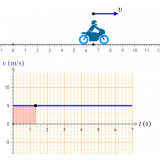
This simulation allows students to study motion with a constant velocity. The students have the ability to change the velocity and the position of the motorcyclist.
Subject Domains
- Astronomical Objects And Their Characteristics
- Astronomy Related Sciences And Fields Of Study
- Effect And Phenomena
- Terms And Concepts
- Botany
- Ecology
- Humans And Animals
- Life Processes
- Variation, Inheritance And Evolution
- Analytical Chemistry
- Chemical Reactions
- Inorganic Chemistry
- Organic Chemistry
- Physical Chemistry
- Biomedical Engineering
- Civil Engineering
- Electrical Engineering
- Mechanical Engineering
- Climate
- Energy
- Environment
- Environmental Protection
- Natural Resources
- Earth Science
- Geography
- Algebra And Number Theory
- Applied Mathematics
- Differential And Difference Equation
- Geometry
- Logic And Foundations
- Numbers And Computation
- Statistics And Probability
- Topic From Subjects
- Electricity And Magnetism
- Energy
- Fields
- Forces And Motion
- High Energy Physics
- History Of Science And Technology
- Light
- Radioactivity
- Solids, Liquids And Gases
- Sound
- Technological Applications
- Tools For Science
- Useful Materials And Products
- Waves
- Computer Science And Technology
- Design
- Electricity - Electronics
- Industry
- Mechanics
- Production
Astronomy
Biology
Chemistry
Engineering
Environmental Education
Geography And Earth Science
Mathematics
Physics
Technology
Big Ideas Of Science
- Energy Transformation
- Fundamental Forces
- Our Universe
- Structure Of Matter
- Microcosm (Quantum)
- Evolution And Biodiversity
- Organisms And Life Forms
- Planet Earth
Lab Types
- Remote Lab
- Virtual Lab
- Data Set
Age Ranges
- Before 7
- 7-8
- 9-10
- 11-12
- 13-14
- 15-16
- Above 16
Languages
- Afrikaans
- Albanian
- Arabic
- Basque
- Belarusian
- Bosnian
- Bulgarian
- Catalan
- Central Khmer
- Croatian
- Czech
- Danish
- Dutch
- English
- Estonian
- Finnish
- French
- Galician
- Georgian
- German
- Greek
- Haitian
- Hindi
- Hungarian
- Icelandic
- Italian
- Japanese
- Kannada
- Kazakh
- Korean
- Kurdish
- Lao
- Latvian
- Macedonian Slavic
- Malay
- Malayalam
- Maori
- Marathi
- Norwegian Bokmål
- Norwegian Nynorsk
- Oriya
- Persian
- Polish
- Portuguese
- Pushto
- Romanian
- Russian
- Serbian
- Simplified Chinese
- Sinhala
- Slovak
- Slovenian
- Spanish
- Swahili
- Swedish
- Tamil
- Telugu
- Thai
- Tibetan
- Traditional Chinese
- Turkish
- Turkmen
- Ukrainian
- Vietnamese
- Welsh
Apply
Reset
Online labs provide students with the possibility to conduct scientific experiments in an online environment. Remotely-operated labs (remote labs) offer an opportunity to experiment with real equipment from remote locations. Virtual labs simulate the scientific equipment. Data sets present data from already performed lab experiments. Please use the filters on the right to find appropriate online labs for your class.
Please note that the Go-Lab Authoring Platform Graasp is no longer maintained. This means that it is not possible to create and publish new Go-Lab Inquiry Learning Spaces using the labs listed on this page. However, you can still access the labs and use them directly on the providers' websites with help of the preview links, which you will find on the dedicated lab pages. If you are interested in creating and using Inquiry Learning Spaces in your classroom, please visit the new Authoring Platform Graasp.org
If you are looking for online labs selected for the curricula of Benin, Kenya or Nigeria, please visit our Collections page.
Sort by
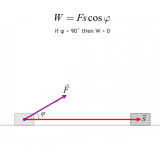
This simulation allows students to study the work of a fixed force. Students have the ability to change the force, angle, and displacement.
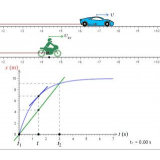
This simulation allows students to explore the movement of two objects with average velocity. Students can compare the movements of these objects using graphs and data about position and time.
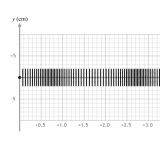
This simulation allows students to study longitudinal waves. Students have the ability to change the direction, amplitude, velocity, and frequency of the wave.
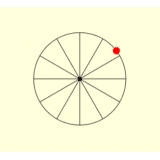
In this lab, you can observe a ball experiencing uniform circular motion, which means it travels in a circle at a constant speed. Use the sliders to adjust the speed and the radius of the path.
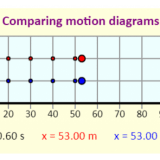
This lab shows the 'dot-plot' motion diagram of 2 moving cars. You can use the sliders to modify the position, velocity, and acceleration of both the cars and compare the resulting motion diagrams.
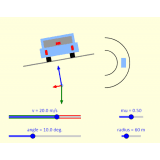
The simulation shows a car going around a banked turn. The car is, we hope, experiencing uniform circular motion, moving in a horizontal circle. In the simulation, you see the rear view of the car, an overhead view of the car, as well as the car's free-body diagram.
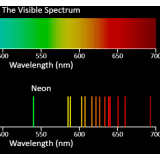
You can observe the light emitted by excited gas atoms of particular elements in this lab. In some sense, these are atomic fingerprints. Note that the lines are shown are the brightest lines in a spectrum - you may be able to see additional lines if you look at the spectrum from a real gas tube.
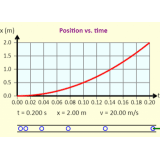
The simulation shows five different motions in which objects experience constant acceleration, starting from rest. Use the buttons to select the motion, and to switch between graphing velocity or position on the vertical axis.
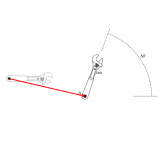
This simulation allows students to analyse the motion of an object. Students have the ability to change the reference point, velocity, angle, and angular velocity of the object.