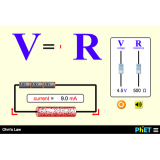
See how the equation form of Ohm's law relates to a simple circuit. Adjust the voltage and resistance, and see the current change according to Ohm's law. The sizes of the symbols in the equation change to match the circuit diagram.
Sample Learning Goals
Subject Domains
- Astronomical Objects And Their Characteristics
- Astronomy Related Sciences And Fields Of Study
- Effect And Phenomena
- Terms And Concepts
- Botany
- Ecology
- Humans And Animals
- Life Processes
- Variation, Inheritance And Evolution
- Analytical Chemistry
- Chemical Reactions
- Inorganic Chemistry
- Organic Chemistry
- Physical Chemistry
- Biomedical Engineering
- Civil Engineering
- Electrical Engineering
- Mechanical Engineering
- Climate
- Energy
- Environment
- Environmental Protection
- Natural Resources
- Earth Science
- Geography
- Algebra And Number Theory
- Applied Mathematics
- Differential And Difference Equation
- Geometry
- Logic And Foundations
- Numbers And Computation
- Statistics And Probability
- Topic From Subjects
- Electricity And Magnetism
- Energy
- Fields
- Forces And Motion
- High Energy Physics
- History Of Science And Technology
- Light
- Radioactivity
- Solids, Liquids And Gases
- Sound
- Technological Applications
- Tools For Science
- Useful Materials And Products
- Waves
- Computer Science And Technology
- Design
- Electricity - Electronics
- Industry
- Mechanics
- Production
Astronomy
Biology
Chemistry
Engineering
Environmental Education
Geography And Earth Science
Mathematics
Physics
Technology
Big Ideas Of Science
- Energy Transformation
- Fundamental Forces
- Our Universe
- Structure Of Matter
- Microcosm (Quantum)
- Evolution And Biodiversity
- Organisms And Life Forms
- Planet Earth
Lab Types
- Remote Lab
- Virtual Lab
- Data Set
Age Ranges
- Before 7
- 7-8
- 9-10
- 11-12
- 13-14
- 15-16
- Above 16
Languages
- Afrikaans
- Albanian
- Arabic
- Basque
- Belarusian
- Bosnian
- Bulgarian
- Catalan
- Central Khmer
- Croatian
- Czech
- Danish
- Dutch
- English
- Estonian
- Finnish
- French
- Galician
- Georgian
- German
- Greek
- Haitian
- Hindi
- Hungarian
- Icelandic
- Italian
- Japanese
- Kannada
- Kazakh
- Korean
- Kurdish
- Lao
- Latvian
- Macedonian Slavic
- Malay
- Malayalam
- Maori
- Marathi
- Norwegian Bokmål
- Norwegian Nynorsk
- Oriya
- Persian
- Polish
- Portuguese
- Pushto
- Romanian
- Russian
- Serbian
- Simplified Chinese
- Sinhala
- Slovak
- Slovenian
- Spanish
- Swahili
- Swedish
- Tamil
- Telugu
- Thai
- Tibetan
- Traditional Chinese
- Turkish
- Turkmen
- Ukrainian
- Vietnamese
- Welsh
Apply
Reset
Online labs provide students with the possibility to conduct scientific experiments in an online environment. Remotely-operated labs (remote labs) offer an opportunity to experiment with real equipment from remote locations. Virtual labs simulate the scientific equipment. Data sets present data from already performed lab experiments. Please use the filters on the right to find appropriate online labs for your class.
Please note that the Go-Lab Authoring Platform Graasp is no longer maintained. This means that it is not possible to create and publish new Go-Lab Inquiry Learning Spaces using the labs listed on this page. However, you can still access the labs and use them directly on the providers' websites with help of the preview links, which you will find on the dedicated lab pages. If you are interested in creating and using Inquiry Learning Spaces in your classroom, please visit the new Authoring Platform Graasp.org
If you are looking for online labs selected for the curricula of Benin, Kenya or Nigeria, please visit our Collections page.
Sort by
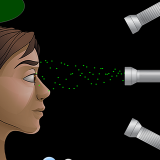
Make a whole rainbow by mixing red, green, and blue light. Change the wavelength of a monochromatic beam or filter white light. View the light as a solid beam, or see the individual photons.Aims of the lab:
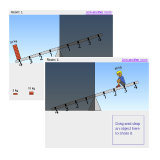
Students working at a distance in two different ILSs share a seesaw, but can only interact with one side of the seesaw. They are able to place objects of different masses onto four different positions on their side of the seesaw. They can pass objects back and forth between each other.
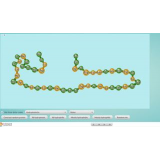
Explore how hydrophobic and hydrophilic interactions cause proteins to fold into specific shapes. Proteins, made up of amino acids, are used for many different purposes in the cell. The cell is an aqueous (water-filled) environment.
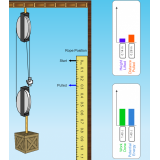
This simulation allows students to visualize some characteristics of a working pulley such as applied force, work, pulled distance. Changing load, distance to lift and pulley diameter students can see how these variables influence the result.
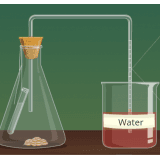
This lab is used to study the rate of respiration in germinating seeds having different substances such as wheat (carbohydrates), mustard (fats) and bean (proteins).
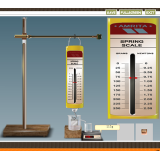
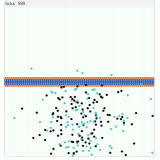
This simulation visualizes the process of diffusion accross a semipermeable membrane and helps to explore the role of this phenomenon in body functioning.
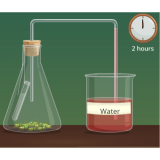
This lab, through an experimental set-up, shows that carbon dioxide is released during aerobic respiration. This lab can also be used to study the effect of temperature on the rate of respiration.
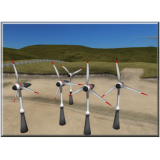
Welcome to the GoLab Wind Energy Simulation. Take control of a wind farm to provide electricil energy to a small town. Understand how random changes - in wind speed and power requirement of the town - affect the use of this natural energy resource.