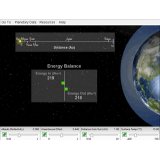
Climate is regulated by the delicate balance of incoming and outgoing electromagnetic radiation. This applet first explores the climatic condition of various planets, focusing on Mars, Venus, and Earth.
Subject Domains
- Astronomical Objects And Their Characteristics
- Astronomy Related Sciences And Fields Of Study
- Effect And Phenomena
- Terms And Concepts
- Botany
- Ecology
- Humans And Animals
- Life Processes
- Variation, Inheritance And Evolution
- Analytical Chemistry
- Chemical Reactions
- Inorganic Chemistry
- Organic Chemistry
- Physical Chemistry
- Biomedical Engineering
- Civil Engineering
- Electrical Engineering
- Mechanical Engineering
- Climate
- Energy
- Environment
- Environmental Protection
- Natural Resources
- Earth Science
- Geography
- Algebra And Number Theory
- Applied Mathematics
- Differential And Difference Equation
- Geometry
- Logic And Foundations
- Numbers And Computation
- Statistics And Probability
- Topic From Subjects
- Electricity And Magnetism
- Energy
- Fields
- Forces And Motion
- High Energy Physics
- History Of Science And Technology
- Light
- Radioactivity
- Solids, Liquids And Gases
- Sound
- Technological Applications
- Tools For Science
- Useful Materials And Products
- Waves
- Computer Science And Technology
- Design
- Electricity - Electronics
- Industry
- Mechanics
- Production
Astronomy
Biology
Chemistry
Engineering
Environmental Education
Geography And Earth Science
Mathematics
Physics
Technology
Big Ideas Of Science
- Energy Transformation
- Fundamental Forces
- Our Universe
- Structure Of Matter
- Microcosm (Quantum)
- Evolution And Biodiversity
- Organisms And Life Forms
- Planet Earth
Lab Types
- Remote Lab
- Virtual Lab
- Data Set
Age Ranges
- Before 7
- 7-8
- 9-10
- 11-12
- 13-14
- 15-16
- Above 16
Languages
- Afrikaans
- Albanian
- Arabic
- Basque
- Belarusian
- Bosnian
- Bulgarian
- Catalan
- Central Khmer
- Croatian
- Czech
- Danish
- Dutch
- English
- Estonian
- Finnish
- French
- Galician
- Georgian
- German
- Greek
- Haitian
- Hindi
- Hungarian
- Icelandic
- Italian
- Japanese
- Kannada
- Kazakh
- Korean
- Kurdish
- Lao
- Latvian
- Macedonian Slavic
- Malay
- Malayalam
- Maori
- Marathi
- Norwegian Bokmål
- Norwegian Nynorsk
- Oriya
- Persian
- Polish
- Portuguese
- Pushto
- Romanian
- Russian
- Serbian
- Simplified Chinese
- Sinhala
- Slovak
- Slovenian
- Spanish
- Swahili
- Swedish
- Tamil
- Telugu
- Thai
- Tibetan
- Traditional Chinese
- Turkish
- Turkmen
- Ukrainian
- Vietnamese
- Welsh
Apply
Reset
Online labs provide students with the possibility to conduct scientific experiments in an online environment. Remotely-operated labs (remote labs) offer an opportunity to experiment with real equipment from remote locations. Virtual labs simulate the scientific equipment. Data sets present data from already performed lab experiments. Please use the filters on the right to find appropriate online labs for your class.
Please note that the Go-Lab Authoring Platform Graasp is no longer maintained. This means that it is not possible to create and publish new Go-Lab Inquiry Learning Spaces using the labs listed on this page. However, you can still access the labs and use them directly on the providers' websites with help of the preview links, which you will find on the dedicated lab pages. If you are interested in creating and using Inquiry Learning Spaces in your classroom, please visit the new Authoring Platform Graasp.org
If you are looking for online labs selected for the curricula of Benin, Kenya or Nigeria, please visit our Collections page.
Microcosm (Quantum)
Sort by
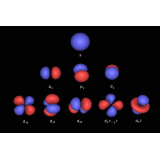
Atomic orbitals are mathematical functions that describe the properties of electrons in atoms.Using this lab, you will learn how to build atomic orbitals according to the general principals involved and you will also be able to visualize their shapes.
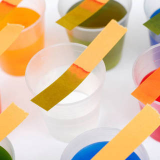
How do strong and weak acids differ? Use lab tools on your computer to find out! Dip the paper or the probe into solution to measure the pH, or put in the electrodes to measure the conductivity. Then see how concentration and strength affect pH.
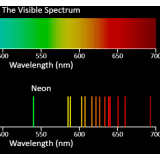
You can observe the light emitted by excited gas atoms of particular elements in this lab. In some sense, these are atomic fingerprints. Note that the lines are shown are the brightest lines in a spectrum - you may be able to see additional lines if you look at the spectrum from a real gas tube.
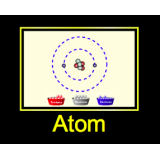
Build an atom out of protons, neutrons, and electrons, and see how the element, charge, and mass change. Then play a game to test your ideas!
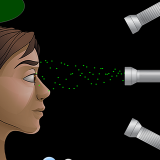
Make a whole rainbow by mixing red, green, and blue light. Change the wavelength of a monochromatic beam or filter white light. View the light as a solid beam, or see the individual photons.Aims of the lab:
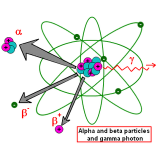
The Radioactivity Lab examines the intensity of radiation over distance, demonstrating the effects of the inverse square law.
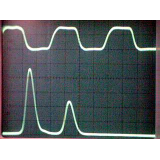
The determination of the speed of light is always a challenge for accurate measurements, since Gallileo four hundred years ago supposed that light is travelling with a finite velocity.
Bond (from bonding in chemistry) helps students learn about solubility and precipitation of salts. Bond contains a database with thousands of salts and the most common ions, with information about solubility and colours. The setup is similar to what students would do in a real chemistry lab.
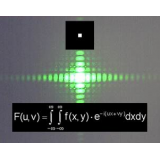
If scattering objects are irradiated diffraction pattern are produced, which are colorful and asthetic. These patterns appear learners very complex, because of many reasons.