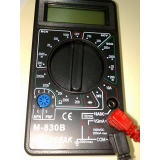
The resistance of an electrical conductor depends on several factors. Its physical shape is one factor. The type of conductor material is another, as might be expected. That is, two conductors with the same physical shape, but of different materials, have different resistances.
Subject Domains
- Astronomical Objects And Their Characteristics
- Astronomy Related Sciences And Fields Of Study
- Effect And Phenomena
- Humans In Space
- Terms And Concepts
- Anatomy
- Botany
- Ecology
- Humans And Animals
- Life Processes
- Variation, Inheritance And Evolution
- Analytical Chemistry
- Chemical Reactions
- Inorganic Chemistry
- Organic Chemistry
- Physical Chemistry
- Aerospace Engineering
- Civil Engineering
- Electrical Engineering
- Mechanical Engineering
- Production Engineering
- Transport Engineering
- Climate
- Energy
- Environment
- Environmental Protection
- Natural Resources
- Earth Science
- Geography
- Algebra And Number Theory
- Analysis
- Applied Mathematics
- Differential And Difference Equation
- Geometry
- Logic And Foundations
- Numbers And Computation
- Statistics And Probability
- Topic From Subjects
- Electricity And Magnetism
- Energy
- Fields
- Forces And Motion
- High Energy Physics
- History Of Science And Technology
- Light
- Radioactivity
- Solids, Liquids And Gases
- Sound
- Technological Applications
- Tools For Science
- Useful Materials And Products
- Waves
- Computer Science And Technology
- Construction - Architecture
- Design
- Electricity - Electronics
- Industry
- Internet
- Mechanics
- Production
Astronomy
Biology
Chemistry
Engineering
Environmental Education
Geography And Earth Science
Mathematics
Physics
Technology
Big Ideas Of Science
- Energy Transformation
- Fundamental Forces
- Our Universe
- Structure Of Matter
- Microcosm (Quantum)
- Evolution And Biodiversity
- Organisms And Life Forms
- Planet Earth
Age Ranges
- Before 7
- 7-8
- 9-10
- 11-12
- 13-14
- 15-16
- Above 16
Languages
- Arabic
- Basque
- Bulgarian
- Catalan
- Croatian
- Czech
- Danish
- Dutch
- English
- Estonian
- Finnish
- French
- Galician
- Georgian
- German
- Greek
- Hungarian
- Indonesian
- Irish
- Italian
- Latvian
- Lithuanian
- Macedonian Slavic
- Polish
- Portuguese
- Romanian
- Russian
- Serbian
- Simplified Chinese
- Slovak
- Spanish
- Swedish
- Traditional Chinese
- Turkish
- Ukrainian
Apply
Reset
Inquiry Learning Spaces (ILSs) are personalized learning resources for students, including a lab, apps, and any other type of multimedia material. ILSs follow an inquiry cycle. Inquiry cycles can differ but the basic Go-Lab cycle consists of the phases Orientation, Conceptualisation, Investigation, Conclusion, and Discussion. The aim of an ILS is to provide students with an opportunity to conduct scientific experiments, being guided through the inquiry process and supported at each step.
This page presents ILSs created by teachers or the Go-Lab and/or Next-Lab team (and often in co-creation), on a large set of domains and in many languages. Please note that the Go-Lab Authoring Platform Graasp is no longer maintained. This means that it is not possible to create and publish new Go-Lab ILSs, preview or copy ILSs listed on this page. It is only possible to view the descriptions of ILSs, which were created and published during the lifetime of the Go-Lab projects. This page can be used for your information only. If you are interested in creating and using Inquiry Learning Spaces in your classroom, please visit the new Authoring Platform Graasp.org
If you are looking for Inquiry Learning Spaces created especially for the curricula of Benin, Kenya or Nigeria, please visit our Collections page.
Sort by
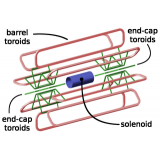
Students will study the motion of a charged particle in a magnetic field, in order to determine the strength of the field of one of the ATLAS magnets, used to measure the momentum of the particles produced by particle collisions at the CERN LHC accelerator.
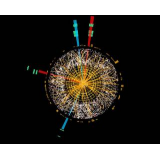
Students will use the experimental data collected by the ATLAS experiment at CERN to “discover” invisible particles and calculate their mass. For this purpose they will use Einstein’s famous equation for the equivalence of mass and energy.
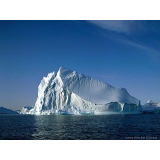
Pupils have to develop a research about Archimedes’ Principle to answer the question in the title. This ILS has been designed to be worked in 3 didactical hours, preferably in couples.
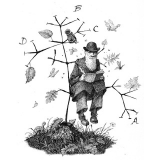
A teoria da Selecção Natural apresentada em 1859 no livro "A origem das espécies" escrito por Charles Darwin é uma das teorias fundamentais da Biologia.

Estudo de algumas propriedades das funções exponencial e logarítmica.
Study of some properties of the Exponential and Logarithmic functions.
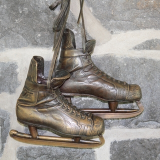
O que é a pressão e com o que está relacionada? No final desta atividade vais conseguir responder a esta e outras questões!

Nesta atividade vais tentar descobrir o que é a densidade e a densidade relativa.Material para a aula:- Ludiões- Cubos para determinação de densidade- Balança- Colas zero e regular- Aquário- Sal

Esta atividade procura levar os alunos à descoberta das características dos estados físicos: sólido, líquido e gasoso.Material necessário para apoio à aula:- seringas de diferentes dimensões- água- cubos sólidos de metal
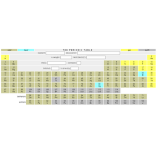
Esta ILS pretende que os alunos desenvolvam as competências relativamente às propriedades periódicas dos elementos.